
How to Reduce PFAS Exposure with Proven Water Treatment Solutions
Per- and polyfluoroalkyl substances (PFAS), commonly known as "forever chemicals," have become one of the most significant water quality challenges facing municipalities, manufacturers, commercial facilities, and homeowners. Because these synthetic chemicals resist heat, grease, oil, and water, they have been used in thousands of industrial and consumer products for more than 70 years. Unfortunately, that same durability prevents them from breaking down naturally, allowing them to persist in soil, groundwater, rivers, lakes, and drinking water supplies.
Today, PFAS contamination affects communities throughout the United States, prompting stricter regulations and increased demand for advanced water treatment technologies. Organizations responsible for public water systems, industrial process water, food manufacturing, and wastewater treatment must now evaluate how PFAS impacts their operations and develop effective strategies for reducing these contaminants.
At DeLoach Industries, we understand that every water source presents unique challenges. Since 1959, we have engineered customized water purification systems that help municipalities, industrial facilities, food processors, distilleries, and commercial organizations improve water quality through proven treatment technologies designed for long-term performance.
What Are PFAS?
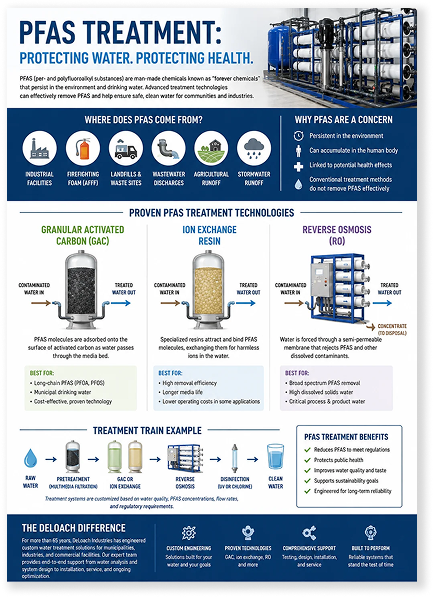
PFAS (Per- and Polyfluoroalkyl Substances) are a family of several thousand synthetic chemicals developed during the 1940s for their exceptional resistance to heat, chemicals, grease, oil, and moisture.
These characteristics made PFAS valuable across numerous industries, including:
-
Aerospace
-
Electronics manufacturing
-
Chemical processing
-
Firefighting foam production
-
Textile manufacturing
-
Food packaging
-
Metal finishing
-
Automotive manufacturing