
AI Controls
• INTELLIGENT AUTOMATION FOR WATER & WASTEWATER
Automation You Can Trust
Smarter monitoring, fewer failures, and lower operating costs for industrial, commercial, and municipal treatment plants.
• OUR STANDARDS
AI Controls that Raise Quality & Reliability
Built for the Complexity of Modern Treatment Plants
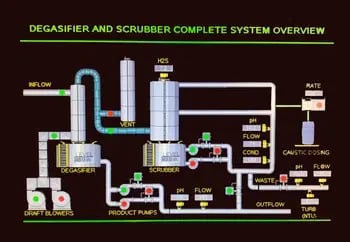
Industrial plants are automating faster than ever, driven by the need for efficiency, safety, and cost control. Artificial intelligence sits at the center of that shift, from a stand-alone control panel that manages a single device to a system that monitors an entire process plant and every surrounding parameter.
Operations like semiconductors, oil and gas, and manufacturing run their own water treatment processes with demanding capacity needs and strict quality requirements. A single plant can rely on hundreds of inputs and outputs to stay in spec, which is exactly the kind of complexity AI is built to manage.
• THE ADVANTAGE
The Use of AI in Industrial Plants Delivers Real Gains
Three benefits show up in nearly every development, from the control room to the balance sheet
• SAFETY & SAVINGS
Safer Plants, Lower Costs
AI makes a plant safer for the people who run it. At the same time, it protects the bottom line by optimizing resources and cutting energy use.
As the technology matures, it keeps moving deeper into everyday operations, and the plants that adopt it early gain a durable edge in reliability and cost.
• INSIDE THE PROCESS
What AI Does Inside These Operations
Continuous oversight that reacts in real time, and often before a problem develops.
• APPLICATIONS
AI Controls in Practice
Six areas where integrating AI reshapes plant performance.
-
Labor costs keep climbing and skilled operators are hard to find, which makes production delays expensive. AI reduces, and in some cases eliminates, the manual load behind daily tasks. The result is tighter quality control at lower cost, with less risk of failure and a more predictable output for the end user.
-
Beyond cutting waste, AI control systems track inventory more accurately than manual methods. They forecast demand, trigger raw material orders during peak periods, and scale operations up or down using sensor data across the facility. Information that once moved by meeting or email now passes instantly, so conditions are calculated and corrected as they happen.
-
AI runs on instrumentation and sensors that monitor, detect, control, and notify throughout the plant. The software anticipates a rise in energy demand and shuts down non-essential systems to keep costs in check. Grown out of the original Building Management Systems, it now extends to PLCs, motor control, and instrumentation, weighing every variable to find the most cost-effective action, then executing it.
-
Integrating AI into water and wastewater operations helps reduce waste, lower costs, streamline processes, and improve decision-making. Advanced analytics can identify risks and potential failures before they occur, enabling proactive responses that increase reliability, efficiency, and overall operational performance.
-
AI can help water and wastewater facilities maintain compliance by monitoring critical systems, identifying potential issues, and providing early alerts. Predictive monitoring helps prevent failures, spills, and environmental incidents while supporting faster response and more reliable operations.
-
DeLoach Industries Inc. integrates AI into water and wastewater treatment processes to improve efficiency, reliability, and system performance. Technologies such as RO, NF, UF, degasification, decarbonization, filtration, pump systems, and chemical feed systems can all benefit from AI integration. Contact DeLoach Industries to explore how AI can enhance your treatment operations.
• FAQs
AI Controls: Common Questions
-
Automated systems that monitor and manage treatment equipment and processes. They range from a single control panel running one device to a plant-wide system tracking hundreds of inputs and outputs, collecting data, analyzing it, and acting on it to reduce human error.
-
No. They remove the tedious, repetitive work and handle real-time monitoring, which frees operators to focus on higher-value decisions and oversight that still require human judgment.
-
Yes. AI adds continuous monitoring, review, and reporting, with advance alerts for any deviation. It watches critical components and can dispatch a technician automatically, helping you stay ahead of county, state, and federal requirements.
-
RO, NF, and UF membrane treatment, degasification, decarbonation, filtration, green sand filtration, pump systems, and chemical feed systems can all benefit from AI integration.
Ready to Optimize Your Treatment System?
Talk with a DeLoach professional about where AI controls fit in your plant.