
Decarbonation in Water Treatment: Lower CO₂ and Raise pH Efficiently
Municipal and industrial water treatment facilities face a constant challenge: maintaining proper pH while managing dissolved carbon dioxide (CO₂) levels.
Excess CO₂ in water can create operational problems such as low pH, corrosion of equipment, increased chemical consumption, and reduced efficiency of downstream treatment processes.
One of the most effective and economical solutions for controlling CO₂ is decarbonation.
Decarbonation removes dissolved carbon dioxide from water through a gas stripping process. By eliminating CO₂, treatment facilities can naturally increase pH, reduce corrosion potential, and lower operating costs.
Decarbonators are a type of degasification tower designed specifically to remove dissolved carbon dioxide from water using an air-stripping process.
For many municipal utilities and industrial plants, decarbonator towers are an essential part of maintaining stable water chemistry and protecting infrastructure.
This guide explains how carbon dioxide forms in water systems, how it impacts pH, and how decarbonation systems help restore balance in municipal and industrial water treatment processes.
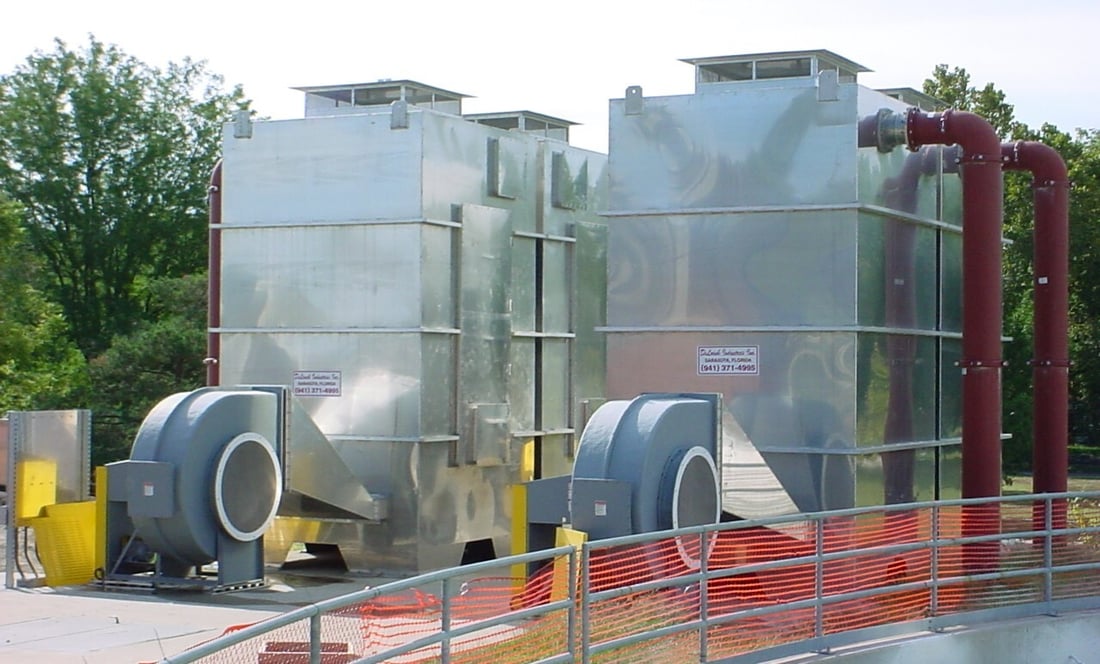
What Does a Decarbonator Do?
A decarbonator removes dissolved carbon dioxide (CO₂) from water through an air-stripping process. Water flows through a packed tower while air moves upward, allowing carbon dioxide to transfer from the water into the air stream. Removing CO₂ reduces carbonic acid formation, raises pH, and helps prevent corrosion in water treatment systems.
Why Does CO₂ Lower the pH of Water?
Carbon dioxide lowers water pH because it reacts with water to form carbonic acid. Carbonic acid partially dissociates into hydrogen ions and bicarbonate ions. The increase in hydrogen ions makes the water more acidic, which lowers the pH.
Chemical reaction:
CO₂ + H₂O ⇌ H₂CO₃
When Is Decarbonation Required in Water Treatment?
Decarbonation is typically used when water contains elevated levels of dissolved carbon dioxide that cause low pH, corrosion, or excessive chemical consumption. It is commonly applied in municipal water treatment, industrial process water systems, boiler feedwater preparation, and high-purity water production.
What Is Decarbonation in Water Treatment?
Decarbonation in water treatment is the process of removing dissolved carbon dioxide (CO₂) from water using air-stripping towers known as decarbonators or degasifiers. Removing CO₂ reduces carbonic acid levels, raises pH, decreases corrosion potential, and lowers chemical treatment costs in municipal and industrial water systems.
Why Carbon Dioxide Forms in Water
Carbon dioxide occurs naturally in water due to interactions with the atmosphere and biological activity within water sources.
Two common processes introduce CO₂ into water systems.
Atmospheric equilibrium
Water absorbs gases from the atmosphere until equilibrium is reached. Because the atmosphere contains carbon dioxide, a portion dissolves into the water.
Biological decomposition
Organic material in water breaks down through biological activity. As microorganisms decompose organic matter, carbon dioxide is produced as a byproduct.
When carbon dioxide dissolves in water, it reacts to form carbonic acid.
CO₂ + H₂O ⇌ H₂CO₃
Carbonic acid is a weak acid that partially dissociates into hydrogen and bicarbonate ions.
H₂CO₃ ⇌ H⁺ + HCO₃⁻
HCO₃⁻ ⇌ H⁺ + CO₃²⁻
These reactions form part of the carbonate equilibrium system, which controls the relationship between dissolved carbon dioxide, alkalinity, and pH in water systems.
As carbonic acid releases hydrogen ions, the acidity of the water increases and the pH decreases.
How CO₂ Impacts Municipal and Industrial Water Systems
Dissolved carbon dioxide can create several challenges in water treatment processes.
Lower water pH
Excess carbon dioxide forms carbonic acid, which lowers the pH of the water. Low pH conditions can interfere with treatment processes and increase corrosion risk.
Corrosion of equipment
Carbonic acid can corrode metal infrastructure including pipelines, pumps, heat exchangers, and storage tanks. Over time this corrosion increases maintenance costs and shortens equipment lifespan.
Increased chemical consumption
Many treatment facilities add chemicals such as caustic soda, lime, or sodium carbonate to neutralize acidic water. While effective, chemical dosing increases operational costs and complexity.
Removing CO₂ through decarbonation can significantly reduce the amount of chemicals required for pH control.
Reduced efficiency of ion exchange systems
In high-purity water systems, dissolved carbon dioxide increases ionic load and reduces water resistivity. Industrial high-purity water applications often target resistivity levels above approximately 10 megohm-cm to maintain low ionic contamination.
Reducing CO₂ before ion exchange systems helps protect resin beds and improve treatment efficiency.
CO₂ Interactions with Limestone and Natural Minerals
In groundwater systems, carbon dioxide can react with limestone and other carbonate minerals.
A common reaction involves calcium carbonate:
CaCO₃ + CO₂ + H₂O ⇌ Ca²⁺ + 2HCO₃⁻
This reaction dissolves limestone and increases calcium and bicarbonate concentrations in water. As a result, groundwater sources may exhibit higher hardness and alkalinity levels.
Understanding this equilibrium is important when designing treatment systems that must manage both corrosion and scaling potential.
Why Water Treatment Plants Sometimes Lower pH
Many water treatment processes intentionally lower pH as part of gas removal or chemical treatment.
One common example is hydrogen sulfide removal.
Hydrogen sulfide can cause strong odors, corrosion, and operational challenges. Lowering the pH converts sulfide species primarily into dissolved hydrogen sulfide gas (H₂S), which can then be removed through aeration or stripping systems.
After hydrogen sulfide removal, the water must be returned to a neutral or stable pH. Decarbonation is often used at this stage to remove carbon dioxide and naturally raise the pH.
How Decarbonator Towers Work
A decarbonator tower removes dissolved carbon dioxide from water through air stripping.
Typical system components include:
Vertical tower column
Packing media bed
Air blower system
Water distribution system
Exhaust outlet for removed gases
The process works in several stages.
Water distribution
Water enters the top of the tower and is distributed across packing media.
Increased surface area
The packing media spreads water into thin films or droplets, increasing the surface area for gas transfer.
Air flow
A blower forces air upward through the tower where it contacts the descending water.
Gas transfer
Because the concentration of CO₂ is higher in the water than in the air, carbon dioxide transfers into the air stream.
CO₂ removal
The air carrying the carbon dioxide exits through the top of the tower.
This gas transfer process follows Henry’s Law, which describes how dissolved gases move between liquids and gases based on pressure differences.
As CO₂ is removed, carbonic acid levels decrease and the water’s pH rises.
Benefits of Decarbonation
Properly designed decarbonation systems provide several operational advantages.
Lower chemical costs
Reducing CO₂ decreases the need for chemical pH adjustment.
Reduced corrosion
Higher pH helps protect pipelines, pumps, valves, and storage tanks.
Protection of ion exchange systems
Lower carbon dioxide levels reduce the ionic load entering deionization systems and extend resin life.
Improved water quality
Decarbonation stabilizes water chemistry and supports consistent treatment performance.
Reliable operation
Decarbonator towers are mechanically simple systems with long service life and relatively low maintenance requirements.
How Much Can Decarbonation Raise pH?
A properly designed decarbonation system can typically increase water pH by approximately 0.5 to 1.5 pH units depending on the initial carbon dioxide concentration, alkalinity, temperature, and system efficiency.
Accurate system sizing requires determining the concentration of dissolved CO₂ and calculating the required removal efficiency using gas transfer principles based on Henry’s Law.
Common Applications for Decarbonation
Decarbonation systems are widely used in many water treatment applications including municipal water treatment plants, industrial process water systems, boiler feedwater preparation, high-purity water production, and groundwater treatment where dissolved carbon dioxide levels are elevated.
Partner with DeLoach Industries for Decarbonation Solutions
Decarbonation systems must be properly engineered, sized, and integrated into the overall water treatment process.
The experienced engineers at DeLoach Industries, Inc. specialize in designing and manufacturing high-performance decarbonator and degasification systems for municipal and industrial water applications.
Our team can help evaluate water chemistry, determine CO₂ removal requirements, and design the right system to improve efficiency and reduce operating costs.
Contact DeLoach Industries at (941) 371-4995 to speak with our engineering team and learn more about decarbonation solutions.
Related Blog: How Degasification Can Solve Your Water Treatment Issues