
Using a Biological Scrubber to Treat & Remove Contaminants
What Is a Biological Scrubber?
Odor complaints, corrosive gases, and hazardous airborne contaminants are ongoing challenges for municipal wastewater facilities and industrial processing plants. One of the most effective long-term solutions for treating low-level hydrogen sulfide (H2S) and other off-gases is a biological scrubber.
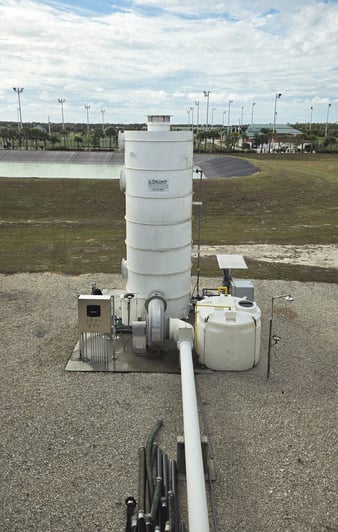
A biological scrubber is a wet air pollution control system designed to remove contaminants from an air stream using naturally occurring microorganisms. Unlike traditional chemical scrubbers that rely primarily on oxidizing chemicals, biological scrubbers use bacteria colonies to biologically digest contaminants before clean air is released into the atmosphere.
These systems are widely used in:
- Wastewater treatment plants
- Lift stations
- Headworks facilities
- Degasification and decarbonation towers
- Industrial process exhaust systems
- Municipal odor control applications
For facilities dealing with persistent H2S odors, corrosion concerns, or environmental compliance requirements, biological scrubbers provide a cost-effective and energy-efficient solution.
For additional odor control technologies, explore DeLoach Industries Odor Control Systems: https://www.deloachindustries.com
Why Hydrogen Sulfide (H2S) Is a Serious Problem
Hydrogen sulfide (H2S) is a colorless gas commonly generated during wastewater treatment and organic decomposition processes. Even at low concentrations, H2S can create severe odor issues that negatively impact workers, nearby communities, and facility infrastructure.
Common Problems Caused by H2S
- Strong “rotten egg” odors
- Corrosion of pipes, equipment, and concrete structures
- Worker safety concerns
- Regulatory compliance violations
- Public complaints from surrounding communities
Health Effects of Hydrogen Sulfide
Exposure to elevated H2S concentrations may cause:
- Eye irritation
- Headaches
- Nausea
- Loss of appetite
- Respiratory irritation
- Fluid accumulation in the lungs at high concentrations
Because of these risks, wastewater facilities must implement reliable odor control and off-gas treatment systems.
The U.S. Occupational Safety and Health Administration (OSHA) provides current workplace exposure guidance for hydrogen sulfide: https://www.osha.gov/hydrogen-sulfide
How a Biological Scrubber Works
A biological scrubber removes contaminants by combining biological digestion with wet scrubbing technology.
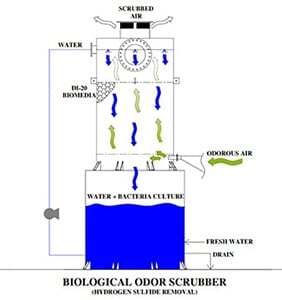
Step-by-Step Process
- Contaminated air is captured
H2S and other gases are collected from treatment areas through a PVC or FRP duct system. - The gas enters the scrubber vessel
The contaminated air stream enters the bottom of a vertical biological scrubber. - Air passes through a biological media bed
The media supports millions of microorganisms specifically cultured to consume contaminants. - Microorganisms digest contaminants
The bacteria use H2S and other compounds as a food source, converting them into byproducts. - pH is controlled continuously
Because biological digestion produces acid, caustic is added to maintain proper pH levels in the recirculating solution. - Cleaned air exits the system
Once treated, the cleaned air is safely exhausted.
Why Media Design Matters
Biological scrubber media is engineered to:
- Support microbial growth
- Maximize airflow
- Reduce pressure drop
- Improve contaminant contact time
- Lower operational energy consumption
Compared to chemical scrubbers, biological systems often require less packing media because contaminants are biologically consumed instead of chemically oxidized.
Learn more about FRP Air Pollution Control Equipment:
https://www.deloachindustries.com/frp-air-pollution-control-equipment/
Best Applications for Biological Scrubbers
Biological scrubbers perform best under stable operating conditions where contaminant concentrations remain relatively constant.
Ideal Conditions
Biological scrubbers are typically most effective when:
- H2S concentrations remain below 10 ppm
- Gas loading rates are predictable
- Airflow remains consistent
- Temperature and humidity are stable
- Contaminant fluctuations are minimal
These systems are especially effective for municipal wastewater facilities that experience steady-state odor generation.
Real-World Example
A municipal lift station consistently producing low-level H2S emissions may benefit significantly from a biological scrubber because the bacteria colony can acclimate to the steady contaminant load.
This often results in:
- Lower chemical usage
- Reduced maintenance requirements
- Improved odor removal efficiency
- Lower long-term operating costs
When a Chemical Scrubber May Be Better
While biological scrubbers are highly effective in the right applications, they are not always the best solution.
Challenges With Variable Gas Loads
Biological systems require time for bacteria colonies to adapt to changing contaminant levels. Rapid spikes in H2S or VOC concentrations can overwhelm the microorganisms and cause “breakthrough,” allowing untreated contaminants to escape.
Situations Better Suited for Chemical Scrubbers
A chemical scrubber may be the better option when:
- Gas concentrations fluctuate rapidly
- VOC concentrations vary throughout the day
- Toxic compounds may harm bacteria colonies
- H2S concentrations exceed biological treatment capacity
- Immediate chemical reaction is required
Chemical scrubbers respond quickly because operators can immediately increase chemical feed rates.
Explore Chemical Scrubber Systems by DeLoach Industries: https://www.deloachindustries.com/odor-control-systems/
The Importance of Proper Air Stream Analysis
One of the biggest mistakes facilities make is selecting odor control equipment before fully understanding the gas composition.
Before choosing a scrubber system, operators should analyze:
- Total contaminant loading
- Hydrogen sulfide concentrations
- Presence of methane or VOCs
- Airflow variability
- Temperature and humidity conditions
- Peak concentration events
Why Multiple Air Samples Matter
A single air sample rarely provides enough information for accurate system design.
Instead, facilities should collect data:
- Over multiple days
- During varying operational loads
- Across seasonal changes when possible
- At different times of day
This ensures the selected system is properly sized and configured for real operating conditions.
Biological vs. Chemical Scrubbers
|
Feature |
Biological Scrubber |
Chemical Scrubber |
|
Best for Stable Loads |
Excellent |
Moderate |
|
Handles Rapid Fluctuations |
Limited |
Excellent |
|
Chemical Consumption |
Low |
Higher |
|
Maintenance Requirements |
Typically Lower |
Moderate to High |
|
Response Time |
Slower Biological Adjustment |
Immediate |
|
Ideal Industries |
Municipal Wastewater |
Industrial & Variable Processes |
AI & Smart Monitoring in Modern Scrubber Systems
Modern odor control systems are becoming increasingly intelligent through automation and predictive monitoring technologies.
DeLoach Industries integrates advanced monitoring and communication capabilities into its systems to improve reliability and reduce operational downtime.
Benefits of Smart Monitoring
Modern systems can:
- Monitor pH levels in real time
- Alert operators to chemical imbalances
- Track airflow and pressure changes
- Detect equipment performance issues
- Improve preventative maintenance scheduling
For example, if a caustic tank level becomes critically low, operators can receive alerts before odor breakthrough occurs.
This proactive approach helps facilities avoid:
- Emergency shutdowns
- Odor complaints
- Equipment corrosion
- Compliance violations
Explore DeLoach Industries Air Pollution Control Solutions:
https://www.deloachindustries.com/air-pollution-control-equipment/
Operational Advantages of Biological Scrubbers
Many wastewater facilities choose biological scrubbers because of their lower operating complexity.
Key Benefits Include:
- Lower chemical consumption
- Reduced maintenance requirements
- Fewer moving components
- Long-term operational savings
- Sustainable biological treatment process
- Effective odor removal for steady-state applications
Biological systems are especially attractive for remote or unattended facilities where maintenance access may be limited.
Because the systems primarily rely on bacterial activity, operators typically only need to manage:
- pH control
- Nutrient feed adjustments
- Periodic system inspections
Choosing the Right Odor Control Partner
Selecting the correct odor control technology is only part of the equation. The experience of the system designer and manufacturer is equally important.
Facilities should work with odor control specialists that understand:
- Wastewater chemistry
- Airflow dynamics
- H2S treatment requirements
- FRP fabrication standards
- Biological treatment processes
- Long-term maintenance considerations
Questions to Ask Before Purchasing
- What contaminant concentrations can the system handle?
- How does the system respond to fluctuating loads?
- What maintenance is required?
- What are the annual operating costs?
- Is remote monitoring available?
- How easily can the system be serviced?
Learn more about Custom Engineered Odor Control Solutions: https://www.deloachindustries.com/odor-control-systems/
Biological scrubbers provide an efficient and environmentally responsible solution for removing hydrogen sulfide and other contaminants from wastewater and industrial air streams. When properly designed and applied in stable operating environments, these systems can deliver excellent odor control performance with reduced chemical usage and lower maintenance requirements.
However, successful implementation depends on accurate air stream analysis, proper system sizing, and selecting the right technology for the application.
Facilities dealing with fluctuating contaminant loads or aggressive VOC mixtures may require alternative solutions such as chemical scrubbers or hybrid systems with carbon polishing stages.
At DeLoach Industries, Inc., our team designs and manufactures advanced odor control and air pollution control systems tailored to the unique demands of municipal and industrial facilities.
Whether you need a biological scrubber, chemical scrubber, or complete odor control solution, our experts can help evaluate your process and recommend the right system for long-term performance and compliance.
Contact DeLoach Industries
Ready to improve odor control and reduce H2S emissions at your facility? Visit DeLoach Industries, Inc. to learn more about custom-engineered scrubber systems and air pollution control solutions.