Aeration, Decarbonation, or Degasification? How to Choose the Right Water Treatment System — and Avoid Costly Mistakes
If your water treatment system isn’t performing as it should, the issue may not be maintenance-related.
It may not be chemistry.It may not even be the equipment.
It may be that the wrong process was selected from the beginning.
Aeration.
Decarbonation.
Degasification.
They sound similar. They often look similar. They even use similar tower designs.
But they solve different problems — and selecting the wrong one can lead to:
- Escalating chemical costs
- Chronic corrosion
- Media fouling
- Odor complaints
- Reduced membrane life
- Compliance risks
For municipal operators, industrial plant managers, and consulting engineers, those aren’t small inconveniences. They’re operational liabilities.
At DeLoach Industries, we help facilities make the right call — not just for startup performance, but for decades of reliable operation.
Let’s walk through the real differences and how to determine what your process truly requires.
What Is Aeration in Water Treatment — and When Is It the Right Choice?
Aeration is the process of introducing oxygen into water to increase dissolved oxygen levels.
Its primary purpose? Initiate oxidation reactions.
When oxygen is introduced into water at its maximum saturation level (which varies with temperature), certain dissolved contaminants can be converted into forms that are removable.
Common Reasons to Use Aeration
Aeration is frequently selected when the goal is to:
- Oxidize iron (Fe²⁺ to Fe³⁺)
- Oxidize manganese
- Reduce hydrogen sulfide
- Improve taste and odor
- Support biological treatment processes
For example:
In groundwater applications, iron exists in a dissolved ferrous state. Without oxidation, it passes straight through filtration. When aeration is properly engineered, oxygen converts ferrous iron into ferric iron — allowing it to settle, coagulate, and filter effectively.
No oxygen transfer? No oxidation.
No oxidation? No removal.
It’s that simple.
What Most Facilities Overlook
Oxygen saturation levels depend heavily on influent water temperature. A system designed without accounting for temperature variation may underperform seasonally.
This is where engineering precision matters.
DeLoach Industries Aeration Systems
Aerators manufactured by DeLoach Industries are:
- NSF-61 certified
- RTP-1 fiberglass compliant
- Available in flows from 5 to 4,500 GPM
- Designed in square or round configurations
- Available in forced or induced draft
For high-iron or heavy scaling applications, square units with self-cleaning PVC slat trays dramatically reduce fouling compared to loose-fill random media.
For lower-fouling, non-iron applications, round packed towers offer high efficiency.
If hydrogen sulfide is present, draft configuration becomes critical to prevent corrosion damage to blower components.
Choosing the correct configuration isn’t optional — it directly impacts operating cost and system lifespan.
Decarbonation — The Hidden Cost Controller in Water Treatment
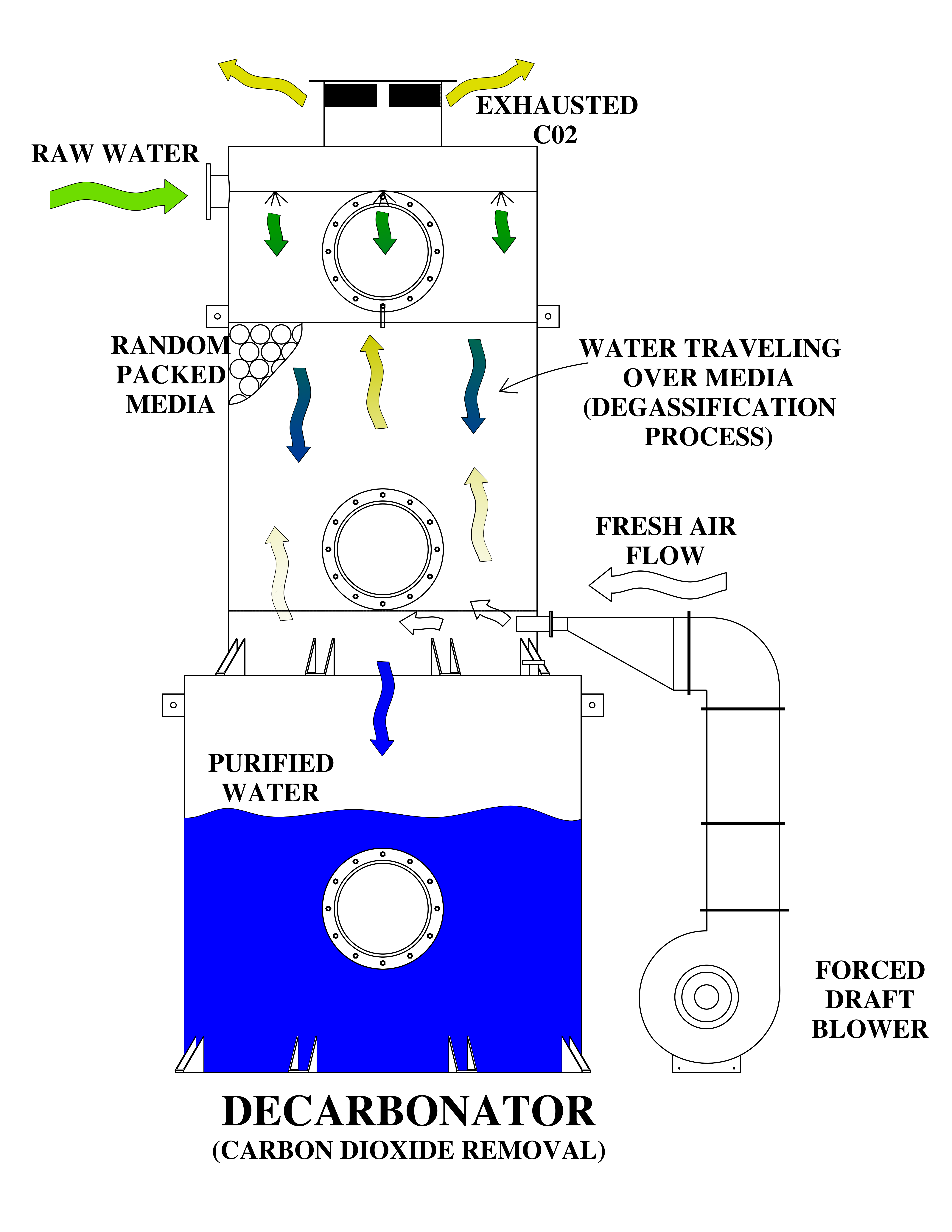
Decarbonation is the removal of carbon dioxide (CO₂) from water. And in many facilities, CO₂ is quietly driving up operating costs.
Carbon dioxide may exist naturally in groundwater or form from carbonic acid reactions. When left untreated, it:
- Lowers pH
- Increases corrosion potential
- Increases lime or caustic feed requirements
- Raises ion exchange regeneration costs
Why CO₂ Removal Impacts Your Budget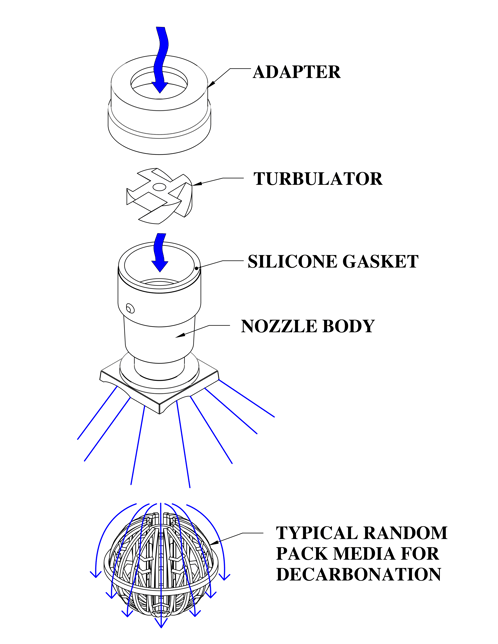
In lime softening systems, failing to remove CO₂ before chemical feed means:
- More lime consumption
- Higher sludge production
- Greater disposal costs
- Increased maintenance
By installing a properly designed decarbonator:
- CO₂ is stripped and vented
- pH rises naturally
- Chemical feed demand decreases
- Long-term operating cost drops
This is not theoretical — it’s measurable.
Where Decarbonators Are Most Commonly Used
- Post-membrane filtration systems
- Prior to anion and cation exchange
- Municipal groundwater treatment
- Food and beverage applications
- Aquaculture facilities
DeLoach Industries manufactures RTP-1 fiberglass and NSF-61 compliant decarbonators for municipal and industrial use, available in:
- Fiberglass
- Aluminum
- 316L food-grade stainless steel
- Rubber-lined carbon steel
For heavy fouling or scaling water, square designs allow slat tray configurations. For ultra-pure applications requiring high efficiency, round packed towers may be selected.
The choice isn’t about preference. It’s about chemistry.
Degasification — The Broad-Spectrum Gas Removal Strategy
Degasification is a broader term that refers to removing dissolved gases from water.
These gases may include:
- Hydrogen sulfide (H₂S)
- Carbon dioxide (CO₂)
- Methane
- Oxygen
- Other entrained gases
It’s important to clarify: removing oxygen requires vacuum or thermal degasification. Standard air stripping systems are typically used for H₂S and CO₂ removal.
Properly designed non-vacuum degasification systems can achieve up to 99.99% removal efficiency when pH and temperature are correctly adjusted.
When Degasification Becomes Critical
If hydrogen sulfide exceeds 1–2 PPM:
- Corrosion accelerates
- Odor complaints increase
- Equipment lifespan shortens
- Worker safety concerns rise
In these cases, a forced draft degasification tower is typically recommended.
Forced draft systems:
- Pull in fresh air at the base
- Protect blowers from corrosive gases
- Vent stripped gases at the top
- Improve long-term equipment durability
Using PVC structural components in high H₂S or CO₂ environments often leads to brittleness, cracking, and premature failure due to UV exposure and vibration stress.
That’s why DeLoach Industries designs degasifiers with:
- RTP-1 FRP construction
- 316L stainless steel options
- Structural materials engineered for high-corrosion environments
We don’t design for the first year. We’ve been designing for decades.
How to Determine Which System You Actually Need
Here’s where many projects go wrong: assumptions.
The correct selection depends on:
- Complete water chemistry analysis
- Langelier Saturation Index (LSI)
- Gas concentrations
- Scaling potential
- Effluent requirements
- Regulatory standards
- Maintenance capability
Step 1: Analyze Raw Water Thoroughly
Before selecting any aeration, decarbonation, or degasification system, a comprehensive water analysis must be reviewed by both the engineer and the equipment supplier.
If the LSI is negative and iron, calcium, or magnesium levels are high, a square tower with slat tray media may reduce fouling and maintenance downtime.
Round towers using random packing offer high removal efficiency but may foul faster in scaling environments.
Ignoring fouling risk during design inevitably increases long-term operating cost.
Operating Cost Is the Real Bottom Line
Initial capital cost is visible.
Lifecycle cost is not — until it becomes a problem.
System selection affects:
- Chemical consumption
- Energy usage
- Media replacement frequency
- Maintenance labor
- Blower replacement cycles
- Downtime risk
A properly engineered forced draft degasifier may cost more upfront than a basic configuration — but it protects against corrosive gas damage and extends blower life.
Over 20 years, that difference is substantial.
Municipal and industrial water treatment is not a short-term investment.
It is infrastructure.
Why Facilities Across the U.S. Trust DeLoach Industries
DeLoach Industries is one of the most experienced manufacturers in the United States specializing in aeration, decarbonation, and degasification systems.
We work directly with:
- Municipal utilities
- Industrial plants
- Consulting engineers
- Design-build contractors
- Food & beverage processors
Our approach includes:
- Technical water chemistry review
- Equipment sizing assistance
- Material selection guidance
- Media configuration recommendations
- Draft configuration analysis
- Long-term performance planning
We do not provide generic, off-the-shelf solutions.
We engineer systems based on your application, your chemistry, and your operational goals.
That’s the difference between equipment supply and engineered partnership.
The Cost of Choosing Wrong — and the Confidence of Choosing Right
Selecting between aeration, decarbonation, and degasification is not simply a terminology decision.
It determines:
- Whether iron is removed effectively
- Whether pH stabilizes naturally
- Whether corrosion is controlled
- Whether chemical costs decline
- Whether blowers survive harsh gas environments
- Whether your facility meets regulatory expectations
If your current system is underperforming, or you are designing a new treatment process, the most important first step is not ordering equipment.
It is asking the right technical questions.
Ready to Engineer the Right Solution?
If you are evaluating:
- A new municipal groundwater installation
- An industrial pretreatment upgrade
- A post-RO gas removal solution
- A high H₂S correction system
- A pH stabilization improvement
DeLoach Industries is ready to assist.
We will review your water chemistry, evaluate your operating conditions, and help you determine whether aeration, decarbonation, or degasification — or a combination, is the correct approach.
Contact DeLoach Industries today at (941) 371-4995 to discuss your municipal or industrial water treatment application.
Your infrastructure and your operating budget will depend on it.