
Caustic solution for Sodium hydroxide water treatment of Sodium Hydroxide
There are many industries that require the use of a caustic scrubber which is considered a chemical scrubber and they range from the municipal industry, mining, semiconductor markets, pulp and paper, and chemical refining. There is a wide variety of industrial processes that generate noxious or corrosive off gases that require treatment and a comparison is made between biological Vs. chemical. Often biological scrubbers have limitations due to concentrations, composition, or temperature of the contaminants and if the gas stream contains acid fumes then a biological scrubber is quickly ruled out.
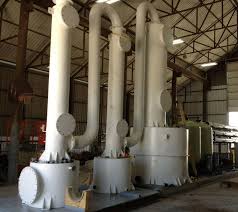
The odor control selection is often fraught with choices of capital cost over operational cost and quite often comes down to familiarity from the designer or purchaser. It is always a good idea to freshen up the industrial odor control the do’s and don’t’s before selecting the final solution. If the off-gas source that needs to be treated is hydrogen sulfide (H2S) or some other type of gas stream produced by an acid or ammonia it will often require neutralization for human health reasons and to protect equipment or may be required to meet regulatory compliance. Caustic scrubbers may be either vertical or horizontal by design, but both utilize a packed media bed of either random packing or trays to allow the gas fumes to meet the recirculating caustic solution which then forces the reaction to occur.
When treating hydrogen sulfide (H2S) gas with caustic scrubbers
Extreme care should be taken based on the loading rate of the H2S. When treating H2S it is normally a good practice to treat the H2S first with a chlorine scrubber to “react” and convert the H2S into “sulfur” which will drop out as a particulate and can be flushed in the waste stream or a biological scrubber if the concentrations are steady and compatible with the biological process and then follow up and polish the residual air that contains H2S with the caustic scrubber.
A high concentration of hydrogen sulfide when treated with a caustic scrubber alone can dissolve into the re-circulation solution containing the Caustic and later during the blow-down phase of the waste stream the pH may rise as dilution occurs which can then release the hydrogen sulfide back again as a gas. Maintaining the proper pH of the scrubber is also critical to make sure the reaction is consistent and to avoid fouling of the scrubber packing. Remember the objective when treating the hydrogen sulfide gas is to convert it into sodium bisulfite. The conversion for this process is this:
H2S + NaOH → NaHS + H2O and NaHS + NaOH → Na2S + H2O
The amount and extent of the reaction will depend on the hydrogen sulfide (H2S) concentration and the strength and availability of the Sodium Hydroxide (NaOH). Sodium bisulfite can be a valuable by-product, but pH levels must be properly maintained during the conversion process, and acid utilized when necessary to adjust the pH. Typically, the sodium bisulfite is sent to waste in the blow-down process stream of the caustic scrubber and not captured. If the caustic scrubber is being utilized to treat an acid fume off the gas stream the reaction process and the equation is totally different and is dependent on the type of acid and its concentration being treated.
In the presence of carbon dioxide (CO2) a caustic scrubber will consume far greater amounts of caustic (NaOH) because the carbon dioxide will interfere with the process and absorb into the NaOH solution affecting the pH and solution.
In addition, with the presence of CO2, there is a high likelihood that the caustic scrubber will produce “salts” from the reaction which will scale and foul the scrubber components like the distribution system and the media bed. DeLoach Industries Inc., a leader, and a major manufacturer of water treatment and odor control systems is implementing artificial intelligence (AI) into their line of odor control scrubbers and industrial water treatment systems including their degasification and decarbonation water systems to allow independent monitoring of all critical components and add the ability to rapidly communicate and adjust to a change in conditions. DeLoach Industries suggest a careful examination and understanding of the air feed source and contaminants should be conducted prior to designing and selecting the treatment system. If carbon dioxide levels are high, then a different treatment process may be required to control operating costs and reduce maintenance cycles. For more information on how to choose which design is right for you contact the professionals at DeLoach Industries at (941) 371-4995.
